

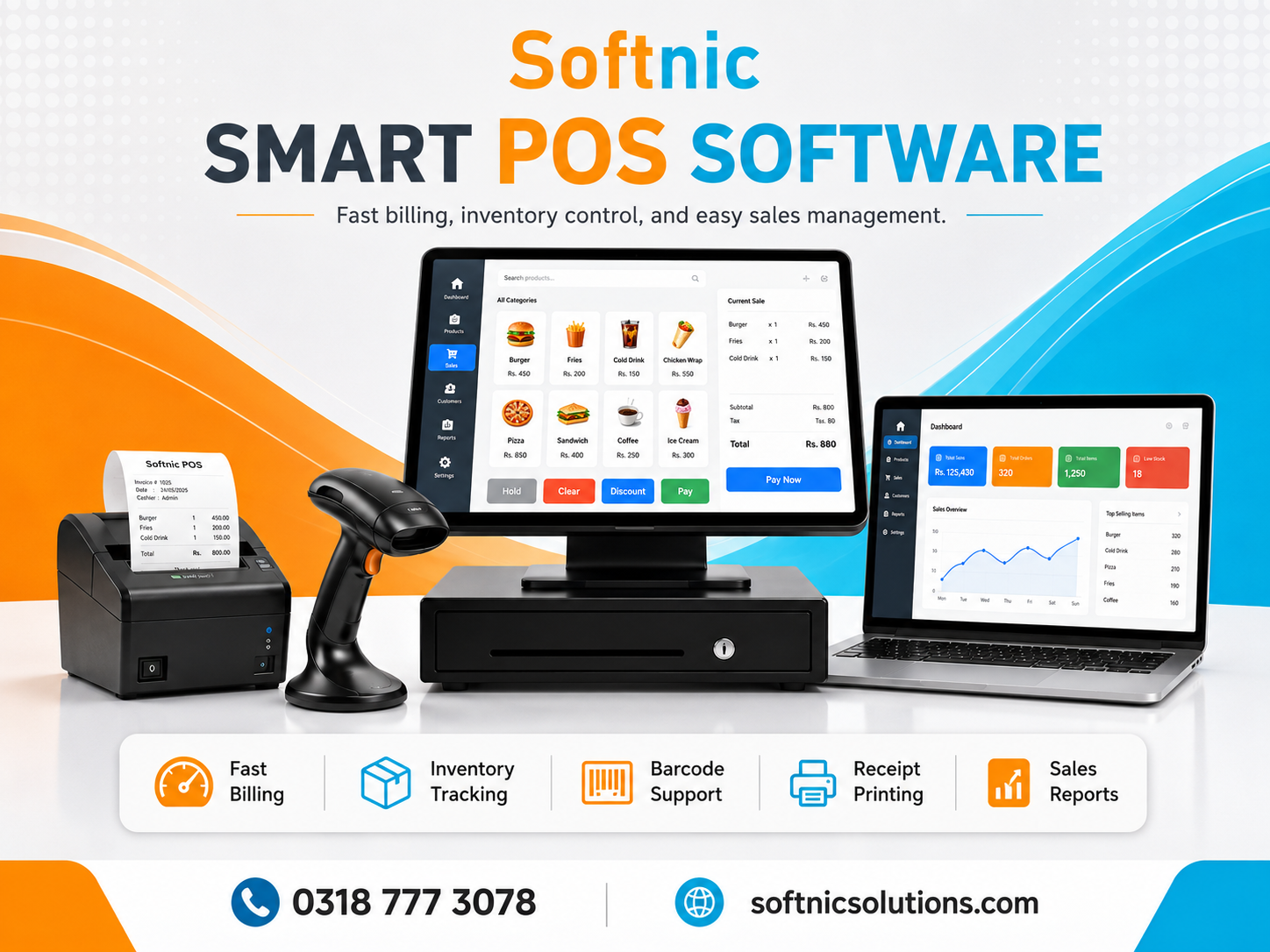
Business Management System Multan
When a business in Multan looks to streamline operations, reduce manual workload, and gain real‑time insights, a Business Management System (BMS) becomes essential. Rather than piecing together spreadsheets, disparate software, or custom scripts, a unified platform offers a single source of truth across finance, inventory, HR, and customer relations. Below is a concise guide to what a BMS can do for Multan‑based companies, why it matters, and how Softnic Solutions can help.
What Is a Business Management System?
A BMS is an integrated suite of applications that automates core business processes. It typically includes:
- Financial & Accounting – invoicing, expense tracking, and reporting.
- Inventory & Order Management – stock levels, procurement, and fulfillment.
- Customer Relationship Management (CRM) – lead tracking, sales pipelines, and service history.
- Human Resources & Payroll – employee records, attendance, and compensation.
- Analytics & Dashboards – real‑time metrics tailored to your KPIs.
By centralizing data, a BMS eliminates duplicate entries, reduces errors, and ensures all departments operate with the same information.
Benefits for Multan Businesses
1. Faster Decision Making
Instant access to dashboards means managers can spot cash flow gaps, inventory shortages, or sales trends within minutes. This agility is critical in a dynamic market like Multan, where seasonal demands and local competition can shift quickly.
2. Cost Savings
Automated workflows cut down manual labor and the risk of human error. For example, a BMS can automatically generate purchase orders when stock drops below a threshold, eliminating the back‑and‑forth emails that consume time.
3. Scalability
Whether you run a small shop or a growing manufacturing unit, a BMS scales with your needs. Adding new product lines, opening new sales channels, or expanding the workforce requires only configuration changes, not a complete system rebuild.
4. Compliance & Transparency
Financial regulations and tax requirements in Pakistan demand accurate record‑keeping. A BMS maintains audit trails and generates compliant reports, simplifying year‑end procedures and reducing legal risk.
Choosing the Right Solution
Not every BMS fits every business. Consider these factors when evaluating options:
- Industry Fit – Does it support industry‑specific workflows (e.g., retail, manufacturing, services)?
- Customization Level – Can you tailor modules to your unique processes?
- Integration Capability – Does it connect with existing tools like POS systems, e‑commerce platforms, or banking APIs?
- Scalability & Cloud Options – Will the system handle future growth and offer reliable uptime?
- Support & Training – Is ongoing technical support and staff training available?
Softnic Solutions’ Approach
Softnic Solutions blends industry expertise with technology proficiency. Here’s how we help Multan businesses adopt a robust BMS:
- Needs Assessment – We map your current processes, pain points, and growth goals.
- System Design – Our developers configure modular components to match your workflow.
- Implementation & Data Migration – Seamless transfer from legacy spreadsheets or software.
- Training & Change Management – Empower your team to use the system effectively.
- Ongoing Support – Continuous updates, performance monitoring, and help desk services.
Beyond a full BMS, Softnic offers specialized modules that complement the core system:
Inventory Management System Multan – Optimizes stock control, reduces carrying costs, and aligns supply with demand.
Business Automation Software Multan – Automates repetitive tasks like email notifications, report generation, and workflow approvals.
Business Management Software Multan – A versatile platform that integrates finance, CRM, and analytics into one interface.
Implementation Roadmap
Phase 1 – Discovery
Workshops with stakeholders to document existing processes, pain points, and desired outcomes.
Phase 2 – Design & Prototyping
Create wireframes and mockups. Validate workflows with key users before development.
Phase 3 – Development & Testing
Build the system in modular increments, perform unit, integration, and user acceptance testing.
Phase 4 – Deployment & Training
Roll out the solution, provide hands‑on training, and supply user manuals.
Phase 5 – Optimization
Collect feedback, monitor usage, and refine features to match evolving business needs.
Case Insight – A Multan Retailer
A local apparel retailer in Multan wanted to reduce out‑of‑stock incidents and improve profit margins. By implementing a BMS with integrated inventory control and point‑of‑sale modules, the retailer achieved a 30% reduction in stockouts and a 15% increase in sales within the first six months. The real‑time analytics dashboard allowed the owner to shift promotions quickly based on inventory levels.
Getting Started
If a Business Management System in Multan is on your agenda, begin with a clear problem statement. Identify which processes cause bottlenecks, then consult with a technology partner that can deliver a tailored solution. Softnic Solutions stands ready to guide you from assessment through full adoption, ensuring your BMS not only meets current demands but also future‑proofs your business.

